This link will send you to the podcast department of the Holocaust Educational Trust website, providing access to numerous podcasts from experts on specific aspects of the Holocaust and some recorded debates.
http://www.het.org.uk/index.php/podcasts-general
Wednesday, 14 September 2011

Monday, 29 August 2011
The ruins of the Warzsaw ghetto
 |
| Click to see this image larger |
Pre-war Polish Culture
This song was written by Wladyslaw Szpilman, a polish Jew living in Warsaw when it became occupied by German armed forces. Renowned for being the inspiration for the film 'The Pianist', he was one of many Jews forced to move into the infamous Warsaw ghetto, which housed approximately 400,000 Jews, 250,000 of whom were later sent to Treblinka death camp where they met their gruesome deaths. Songs like this one, which was written before the German occupation, would have been commonplace in the enormous European classical music scene, though pieces of such somber beauty and relevance were afterward and are now still much more difficult to come by. To an extent, listening to a piece music that comes from somewhere thought of almost entirely in terms of the damage done to it during the holocaust can lead us to see Poland as a country of culture and life, rather than the loss thereof.
Thursday, 14 July 2011
Could it happen again?
Despite the horrors of the Holocaust, many of us believe that most people would stand by and do nothing in the event of a new genocide. After a generation of multiculturalism, we have made some progress. We try to ensure that the workplace is fairer, the school curriculum is more inclusive, and we have more prominent individuals - from newsreaders to footballers, politicians to police - who reflect our diverse society. [extract]
http://www.guardian.co.uk/commentisfree/2007/jan/26/couldithappenagain
Click on this hyperlink to view the entire article which addresses our own consciences in the face of genocide, and the potential that exists for a repeat of the horrors of the Second World War.
http://www.guardian.co.uk/commentisfree/2007/jan/26/couldithappenagain
Click on this hyperlink to view the entire article which addresses our own consciences in the face of genocide, and the potential that exists for a repeat of the horrors of the Second World War.
Sunday, 5 June 2011
From an educator's perspective...
Before this project I had conciously avoided going to Auschwitz feeling uncomfortable about going somewhere where I might feel as though I was trespassing for no good reason as I had already read very widely. Indeed I personally would still not go unless it was for an educational pupose and I was involved in taking students around who otherwise would not engage with the issues concerned through wider reading. I still have some problems with a visit to Auschwitz as it can tend to dominate a persons perception and understanding of what the Holocaust was. That is why in my work for the Holocaust Educational Trust I try my utmost to point out the wider context of Auschwitz wherever I can. I am still trying to work out for myself why I go in the way that I do and whether it is entirely appropriate. To see the pictures of the Jewish people who died there as they would have wished to be remembered (in pictures that they had taken by their families and friends) after walking around Birkenau is the most powerful part of the trip for me and goes some way to explaining the purpose of my visit.
Peter Morgan, Secondary School Teacher and LFA educator
Saturday, 4 June 2011
Evaluating Media - Exercise 1
Look at this advertisement for the 'Say No to AV' campaign.
 What effect does the advertisement have, especially the London Eye?
- a huge 'NO' creates a sense of overwhelming opposition
- London Eye is a commonly used symbol for London, as well as Britain on a whole
- Stormy skies creates an atmosphere of approaching danger
Overall, this advertisement successfully paints voting for 'No' to be doing something that is overwhelmingly supported, and something that is done to prevent some form of 'imminent danger'. These visual techniques are what are and have been used for the last century as a method of portraying a certain (often political) perspective and trying to instil this into the public.
Next time you see an advert (of any kind), consider what visual techniques are being used to sway your opinion and consider whether that is what you really want - these abilities to evaluate modern media are critical in preventing catastrophes similar to those in the past.
(This post bears no political affiliation and does not intend to portray any political party in any negative or positive light)
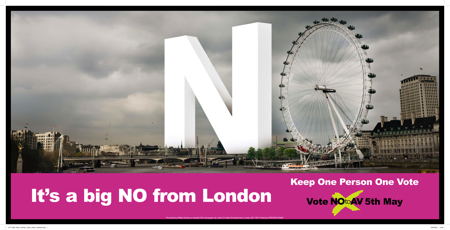
- a huge 'NO' creates a sense of overwhelming opposition
- London Eye is a commonly used symbol for London, as well as Britain on a whole
- Stormy skies creates an atmosphere of approaching danger
Overall, this advertisement successfully paints voting for 'No' to be doing something that is overwhelmingly supported, and something that is done to prevent some form of 'imminent danger'. These visual techniques are what are and have been used for the last century as a method of portraying a certain (often political) perspective and trying to instil this into the public.
Next time you see an advert (of any kind), consider what visual techniques are being used to sway your opinion and consider whether that is what you really want - these abilities to evaluate modern media are critical in preventing catastrophes similar to those in the past.
(This post bears no political affiliation and does not intend to portray any political party in any negative or positive light)
Tuesday, 31 May 2011
Discussion point 2: Teaching the holocaust
The subject is often a delicate one and contains very serious themes, with the potential to cause serious emotional damage to students, so what age should we begin to teach the Holocaust at schools?
"The holocaust should not be taught in schools altogether - if anyone is truly interested in this dark period of human history, they should take the initiative themeselves"
Do you agree or disagree? Share your thoughts and feelings in the comment box below.
"The holocaust should not be taught in schools altogether - if anyone is truly interested in this dark period of human history, they should take the initiative themeselves"
Do you agree or disagree? Share your thoughts and feelings in the comment box below.
Subscribe to:
Posts (Atom)